Average Reviews:

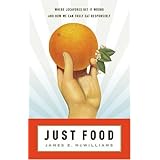
(More customer reviews)Are you looking to buy Just Food: Where Locavores Get It Wrong and How We Can Truly Eat Responsibly? Here is the right place to find the great deals. we can offer discounts of up to 90% on Just Food: Where Locavores Get It Wrong and How We Can Truly Eat Responsibly. Check out the link below:
>> Click Here to See Compare Prices and Get the Best Offers
Just Food: Where Locavores Get It Wrong and How We Can Truly Eat Responsibly ReviewJust Foods is an important book in the continuing (and continually escalating) debate over how we should grow our food and what we should eat. Environmental historian and reformed locavore James McWilliams, invites us to think logically and dispassionately about some of the most important food issues of our time--and of the future. Having read two of McWilliams' previous books, I expected a controversial, detailed, and well-documented discussion. I wasn't disappointed.In summary, McWilliams argues
1) that global food production is more fuel-efficient and more economically necessary (for developing countries that need export markets) than is local food production/consumption ("locovorism");
2) that organic farming is no more healthy for people and for the land than is "wisely practiced" conventional agriculture;
3) that genetically-modified crops, in the right hands, are not to be feared and are in fact necessary to feed the ten billions of people who will live on this planet by 2050;
4) that we must drastically reduce our production and consumption of meat animals and non-farmed fish;
5) and that we must get rid of "perverse" subsidies that undercut fair trade.
Informed readers will likely find themselves in near-total agreement with McWilliams' last two points. Factory-farmed beef consumes 33 calories of fossil fuel for every single calorie of meat produced, as well as creating huge amounts of air, soil, and water pollution and--on the other end--causing serious health problems in those who over-consume. Other animals, including range-farmed animals, may be less damaging to the environment and to their consumers, but still require (by a 3-to-1 ratio) more energy to produce than they offer in return. Wild fish stocks have been harvested to the brink of extinction, and ecologically-sensitive fish-farming may be our only alternative, short of giving up fish altogether. Many readers may agree with McWilliams that "conscientious eaters must radically reduce current rates of consumption" of meat and wild fish if the world's ecosystems are to be saved. Many will also agree that an end must be put to wasteful government incentives such as corn subsidies.
But those same informed readers will find much to argue with in this book, for McWilliams overlooks several hugely important problems--elephants in the garden. As I see them, here they are.
The first elephant: fossil-fuel depletion. While I am sympathetic to McWilliams' arguments that we need to be sensible about "food miles" and make more effort to save energy in food selection and preparation, I feel that he has overlooked one of the most important argument against continuing and/or increasing our dependency on global food markets and conventional fossil-fueled agriculture: that over the next decade or two, oil will become so expensive that food will no longer be shipped halfway around the world. Conventional farming, with its reliance on fossil-fueled equipment, fertilizers, and insecticide, is not viable in the long term. Even the conservative International Energy Agency (IEA) now says that "peak oil" is likely to arrive by 2020 and bring with it skyrocketing fuel costs. Whether we like it or not, when the price of a gallon of gasoline hits double-digits, shortening the food miles from farm to fork may be a necessity. Indeed, many of us may be eating out of our front-yard gardens, raising chickens in the back, and purchasing shares in a neighborhood milk goat. Don't laugh. It's possible.
A second elephant. I would like to accept McWilliams' argument that we must make a kind of peace with biotechnology, and that genetically-modified crops may be important when it comes to feeding fast-growing human populations across the globe--populations that (he says) are on track to exceed the carrying-capacity of the planet. We need the promise of higher yields, drought tolerance, and pest-resistance. But McWilliams brushes aside too easily the huge issues of gene contamination; the failure of GM crops to reduce (as promised) pesticide use; and their failure to produce the promised higher yields. And since GM crops are conventionally-farmed, the challenge of energy depletion must be faced here, too.
Still, it is not the flawed promise of GM crops that will most concern readers. It is the question of private ownership of the world's seeds. McWilliams himself acknowledges that the only place for biotechnology is "the public domain," and that as long as the genes of the world's most important foods are owned and controlled by a "handful of corporations intent on monopolizing patents in the interest of profit," none of its benefits will be achieved.
But that is the elephant. These technologies do not belong to the commons. They are held by monopolistic private corporations. And short of a revolution, corporations will continue to hold them. And as long as this is true, biotechnology is a much greater threat than a promise to the food security of peoples around the world.
A third elephant. Any book that presumes to point definitive directions for global agriculture absolutely must take into account the enormous cloud that looms on all horizons: global warming and climate change. McWilliams addresses this far too briefly. Under changing climate conditions, what kinds of foods will we be able to produce and where? How are these changes likely to affect pests and crop-destroying viruses? Global warming, fossil-fuel depletion, and privately owned crops are the huge elephants in the garden. That these issues are not front-and-center in this book is a substantial disappointment.
As always, I am grateful to James McWilliams for requiring me to read carefully and think about his arguments. While I read, I scribbled in the margin, made notes on the flyleaf, and ticked off the sources I intend to investigate. Just Food engaged me fully and completely--not always comfortably, but always productively.
The bottom line. Just read Just Food. Give yourself time to read (this is not skim-reading stuff) and equip yourself with pencil and paper or your laptop. Bring your own arguments to the table, and measure them against the author's, point by point. And do plan to spend more than a few hours reading and thinking and arguing with this book. You will find that it is time well spent.
Just Food: Where Locavores Get It Wrong and How We Can Truly Eat Responsibly Overview
Want to learn more information about Just Food: Where Locavores Get It Wrong and How We Can Truly Eat Responsibly?
>> Click Here to See All Customer Reviews & Ratings Now