Average Reviews:

(More customer reviews)Are you looking to buy
Rules of Play: Game Design Fundamentals? Here is the right place to find the great deals. we can offer
discounts of up to 90% on
Rules of Play: Game Design Fundamentals. Check out the link below:
>> Click Here to See Compare Prices and Get the Best Offers
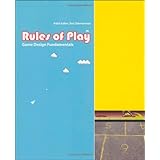
Rules of Play: Game Design Fundamentals ReviewThere are very few books about the theory of game design. Most of the books which purport to be about game design theory have titles like _Game Design: Theory and Practice_ [Richard Rouse III: 2001], and focus much more on the latter than the former, usually in the context of commercial computer games. The exceptions to this rule generally approach the subject of game design theory from a particular perspective, e.g., as a communication method or "future's language." [Duke: 1974] So when _Rules of Play: Game Design Fundamentals_ (by Katie Salen and Eric Zimmerman) was published by MIT Press in 2004, I took immediate interest.
The book largely lived up to expectations. Weighing in at a hefty 672 pages of relatively small type, this textbook-format tome is, as the title might suggest, heavy on game design theory but light on practice. This makes it a excellent complement to the established game design literature.
Structurally, the book is fairly straightforward and is divided into four major sections: Core Concepts, Rules, Play, and Culture, each of which is capped by an essay or a game design by an established game designer written especially for this volume.
The first section (together with two brief chapters preceeding it) discusses necessary background ideas, defining important terms and presenting concepts to be built upon later. Besides preparing the reader for the next 500 pages, it's in this section that the authors accomplish one of their primary goals of the book: creating a game design vocabulary. Creating such a critical vocabulary, they argue, is an important step towards treating game design as a discipline, because you need such a tool to education game designers, to pass skills and knowledge from one generation of designers to another, to faciliate audience-building by enabling critical discussion of games, and finally as a buffer against criticism, by giving "us" -- a word which takes on new meaning in the last third of the book, when they discuss the various ways players become de facto game designers -- the vocabulary and understanding to defend gaming as an activity from those who would censor it. These points are borrowed from an essay by Henry Jenkins, a media theorist and game scholar who is also the head of the Comparative Media Studies program at MIT. (As a quick sidebar, this book may be worth buying for the bibliography alone.) Of course, vocabulary is only the start of an effort to establish a "critical discourse for game design." Or, as Salen and Zimmerman explain, "a critical vocabulary lets us talk to each other."
The last three sections of the book form the beginnings of that critical discourse. Each of these sections highlights a specific primary schema ("a conceptual lens we can apply to the analysis or creation of a game"), with most of the chapters in these sections focusing on related lower-level schemas. For example, in the section on the schema "Games as Play," there is a chapter on "Games as Narrative Play," which examines both narrative elements of games and narrative as a result of game play. These schema-based chapters borrow heavily from a wide variety of disciplines, and it is through these schemas that major insights regarding game design can be found. (For instance, the chapter on "Games as the Play of Pleasure" has an interesting discussion of the importance of short-term goals, which serve both to help players make plans in a game, and also provide moments of satisfaction when these goals are reached.) A lot of these insights will not be new to experienced game designers, but what is new is the systematic framework in which the insight is embedded.
Or, more correctly, frameworks. I would argue that this multiple-perspective approach is the book's primary strength. Rather than taking a given theoretical construct and forcing all of "games" into it, it starts with a few core concepts and then generates a plethora of interrelated-but-distinct models with which to examine any game. Any given model may or may not be suited to an individual game -- or, perhaps more accurately, may or may not have the potential to produce new insights -- but as a whole they are a powerful collection of tools. If you have a hammer, the old saying goes, everything looks like a nail. In this case, Salen and Zimmerman have handed the reader a fairly complete toolbox. (Note that I will admit to shoehorning this analogy into place just a little bit. A hammer is construction tool, not an analysis tool; it's job is on the *practical end*, not the theoretical. A better analogy would be a toolbox that contains an MRI machine, a spectrograph, an x-ray machine, a CAT scanner, and a simple camera, but I don't know of any old sayings that use those particular tools.) This comprehensive approach draws on a wide variety of disciplines, from pyschology and literature to software engineering. Within the field of games it casts an equally wide net, drawing examples from computer games, parlor games, Live Action Roleplaying Games, boardgames, professional sports, schoolyard games, and others. It's not unusual for one paragraph to discuss a game like Chutes and Ladders, the next to discuss professional basketball, and a third to discuss Quake. Such a diverse treatment of the subject guarantees that there is always an example available for a type of game the reader is familar with, even if the inevitable result is a little bit of shoehorning of examples. (I remain unconvinced, for example, that Tic Tac Toe is really a "territorial acquisition" game.) There are also plenty of new games to learn about -- for instance, did you know that someone ran a live action PacMan game in New York City? This comprehensiveness extends to the bibliography and footnotes.
Another strength derives directly from one of the goals of the book: the authors are attempting to create a vocabulary. As a result, they are meticulous about defining terms, especially when they are borrowing concepts from other disciplines. This can occasionally be a little tiresome, but in the end it's always worth the effort.
The weaknesses of the book are in many ways mirror images of the strengths -- it's occasionally too theoretical, too comprehensive, and too multi-disciplinary. It tends to wordiness, and occasionally the authors seem to base significant points on what one could argue is a word game, e.g., they draw upon the definition of play as in "loose" ("too much play in the fan belt") when defining the idea of "playing a game" or "game as a form of play." It's a clever little example of creative pseudo-etymology, but I'm not sure that I buy the construct, even if it does seem to offer insight on occasion. (Note that I originally wrote "play on words" rather than "word game.")
One glaring void in this comprehensive approach, ironically, is that the book doesn't really focus on games that are played for reasons other than the pleasure of the participants. Professional military games are mentioned only in passing, large seminar games not at all, and it's probably safe to say that when one thinks of DOD gaming, such concepts as "Games as Cultural Resistance" (chapter 32) are probably not the sort of idea that comes to mind. Indeed, much of the sections on "Play" and "Culture" might seem to be inapplicable to the type of gaming sponsored by DOD, because they do not address the unique reasons as to why military organizations participate in the creation and playing of games.
I think that conclusion would be a mistake. The motivation as to why individuals play DOD games is certainly different than the motivation of your average _Vampire: The Masqerade_ player, but the mechanisms by which a player finds the experience meaningful probably isn't. A bored or alienated player is bored or alienated, regardless of whether he's playing in the latest first-person shooter on his own initiative or Millenium Challenge because he was told to be there. If anything, these issues might be more important in a military games context: Joe Civilian Gamer can simply stop playing DOOM if he gets bored, but gamers that are forced into situations they don't want to be in have a tendency to cease their willing suspension of disbelief ("step outside the magic circle," as Salen and Zimmerman would say) and cause problems for others as well.
So, in short, I think the book is worth the time and the price tag ($50 list), both for game designers in general and professional military game designers in particular.
Rules of Play: Game Design Fundamentals OverviewWant to learn more information about
Rules of Play: Game Design Fundamentals?
>> Click Here to See All Customer Reviews & Ratings Now