Showing posts with label jamestown. Show all posts

Love and Hate in Jamestown: John Smith, Pocahontas, and the Start of a New Nation Review

Love and Hate in Jamestown: John Smith, Pocahontas, and the Start of a New Nation
Average Reviews:

(More customer reviews)
Are you looking to buy Love and Hate in Jamestown: John Smith, Pocahontas, and the Start of a New Nation? Here is the right place to find the great deals. we can offer discounts of up to 90% on Love and Hate in Jamestown: John Smith, Pocahontas, and the Start of a New Nation. Check out the link below:

>> Click Here to See Compare Prices and Get the Best Offers

Love and Hate in Jamestown: John Smith, Pocahontas, and the Start of a New Nation ReviewWith apologies to Peggy Lee and Walt Disney, they didn't -- but the story of the Indian princess saving Captain John Smith's life is true. In fact, she saved his life on several occasions. But, in the end, believing Smith to be dead, she married another Virginia colonist, John Rolfe, who was not a bad sort although a bit of a prig.
This is the story of the British colony in Virginia from its founding in 1607 until its near destruction by the Indians and reconstruction in the 1620s. Captain John Smith was only in Virginia for the first few years of the colony, but he saved it from disaster over and over again. Surrounded by idle aristocrats who wanted to search for gold rather than grow corn, Smith adopted the no-nonsense policy that those who didn't work didn't eat. Many of the numerous "gentlemen" in the company preferred death to work -- and realized their desires.
I was surprised at how humane and idealistic were the aims of the parent company of Jamestown back in Britain. The company advocated peaceful coexistence with the Indians and there was much criticism of Smith's more aggressive -- and practical -- strategy. In retrospect, it is amazing that Jamestown survived as it was reduced to near nothingness on several occasions by starvation, disease, and Indian attacks. One of the chapters tells of the arrival of the first Negro slaves in the colony -- an ominous portent for the future.
For me the most interesting chapter of the book was about Pocahontas in England and her single meeting after a long separation with John Smith. I was especially amused at the author's speculation that Pocahontas was appalled at the unhealthy and squalid living conditions of the British in London at that time. She died soon afterward, a shame because her memoirs would be even more fascinating than those of Smith. "Love and Hate" is a well-researched and well-written book about a couple whose names will forever be linked in folklore and history.
SmallchiefLove and Hate in Jamestown: John Smith, Pocahontas, and the Start of a New Nation Overview

Want to learn more information about Love and Hate in Jamestown: John Smith, Pocahontas, and the Start of a New Nation?

>> Click Here to See All Customer Reviews & Ratings Now
Read More...

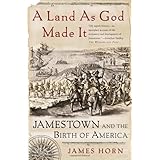
A Land as God Made It: Jamestown and the Birth of America Review

A Land as God Made It: Jamestown and the Birth of America
Average Reviews:

(More customer reviews)
Are you looking to buy A Land as God Made It: Jamestown and the Birth of America? Here is the right place to find the great deals. we can offer discounts of up to 90% on A Land as God Made It: Jamestown and the Birth of America. Check out the link below:

>> Click Here to See Compare Prices and Get the Best Offers

A Land as God Made It: Jamestown and the Birth of America ReviewWe will hear more about the founding of Jamestown, Virginia, as its 400th anniversary approaches in 2007. The anniversary will perhaps restore a balance. According to James Horn, in his stimulating history _A Land as God Made It: Jamestown and the Birth of America_ (Basic Books), many Americans have forgotten Jamestown. They believe that the Pilgrims founded America, but that was in 1620. Even with the appeal of the Jamestown stories of John Smith and Pocahontas, the birth of our nation in Virginia (part of the backwater South) was relegated by professional historians to a status secondary to that of New England (part of the progressive North). The Pilgrims were originally aiming for Virginia, but they missed (or they had a last minute change of plans). It was Jamestown that was the first enduring colony in America, and Jamestown that put into practice three basic principles: "private property in land, a representative assembly for ordering local affairs, and civilian control of the military." Jamestown also was the starting point for slavery in America, and for vicious wars against the indigenous peoples. As Horn notes, America would have been vastly different if Jamestown had failed, and it could have failed at any number of points in its history. This scholarly book, largely through first-hand sources, puts the colony in its rightful place.
Among those first 144 colonists was Captain John Smith, who got into trouble even before landing; he was accused by the leaders of the expedition of plotting "to usurpe the government, murder the Councell, and make himselfe kinge." It isn't clear what the real problem was, but time and again, Smith showed enormous arrogance (an "Ambityous, unworthy, and vayneglorious fellowe") and dissatisfaction when commanded by those he considered less competent than himself (everyone). He was able to stay in the colony less than three years before its leaders sent him back to Britain, never to return. It might have been that British investors in the Virginia Company would have profited from more of his leadership. Smith was a pragmatist who wanted the colony on a sound agricultural footing. The investors, however, were interested in quick riches from finding gold, made moral by bringing the Protestant faith to the Indians. The Company made a huge mistake in neglecting the "smokie weed of Tobacco," which was becoming popular in Europe but which the Company regarded as nothing but a fad. An organized Indian revolt in 1622 hit almost all the English settlements in 1622. By the next year, the Company could not keep its own charter, which was revoked in 1624 and given to the Crown.
"The Virginia Company had collapsed," writes Horn, "not the colony." It was not clear that the Crown would support continuing the settlement, but in 1625 Charles I affirmed that he would keep and protect it as he would all of his other dominions. The Crown supported tobacco growing, as well as economic supports for trade in the weed, and Virginia finally turned a profit. John Smith's idea that vigorous worldwide trade would keep the colony going proved true. Faded were the aims of quickly finding gold, and also lost was the vision of a Christian empire in the new world that would make all the Indians Protestants and form a bulwark against Catholic Spain. As a strictly commercial venture, Jamestown failed, but commerce redeemed the colony; Horn's fascinating and detailed book is a story of human activity in many guises but always fundamentally for profit. That was the basis for the start of our land, and for better or worse has never lost its claim on us.A Land as God Made It: Jamestown and the Birth of America Overview

Want to learn more information about A Land as God Made It: Jamestown and the Birth of America?

>> Click Here to See All Customer Reviews & Ratings Now
Read More...